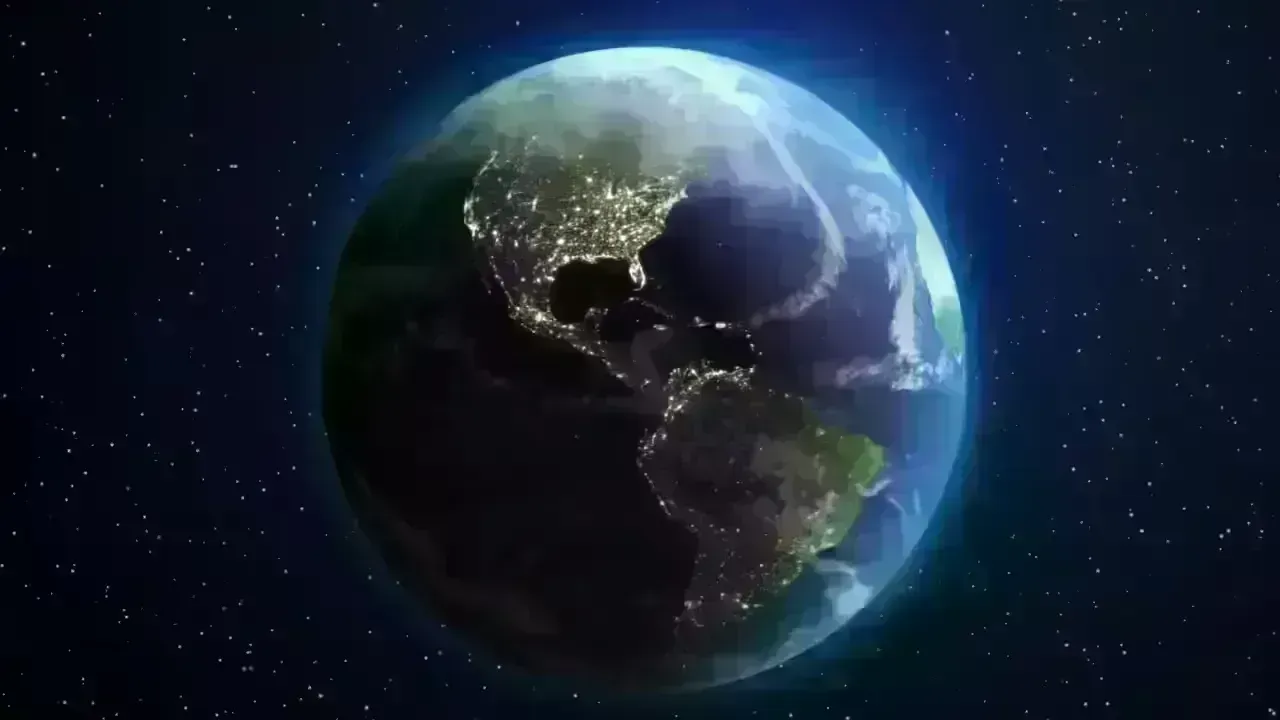
Post by : Anees Nasser
The concept of Earth halting its rotation may sound like a plot from a thrilling science fiction tale. Many envision chaos: humans soaring off into space, oceans flooding continents, or one hemisphere locked in unending cold while the other scorches. However, the actual ramifications of such a halt are vastly more intricate, unsettling, and rooted in scientific understanding.
Earth's rotation is integral to our daily existence, often unnoticed. While we feel still, the planet spins at an impressive 1,670 kilometres per hour at the equator. This movement is vital for gravity’s function, as well as the distribution of weather patterns, ocean currents, and even the functioning of human biology. Taking this motion away would drastically alter our planet in ways beyond recognition.
This article delves into the true outcomes of a scenario where Earth stops spinning—either instantaneously or gradually—and highlights why the most perilous consequences are often misapprehended.
The effect of Earth's rotation extends beyond just separating day from night. It also plays a crucial role in shaping gravity. As the planet spins, centrifugal force counterbalances gravity to some degree, notably at the equator, resulting in Earth being an oblate spheroid rather than a perfect sphere.
Should the spin cease, gravity would soon start reshaping Earth into a more spherical form, leading to new coastlines, inundating extensive regions, and altering the equilibrium between land and water.
Furthermore, the rotation invokes the Coriolis effect, vital for controlling winds and ocean currents. Without it, the mechanisms of global circulation would collapse, leading to catastrophic global climate disruption.
An instant halt would turn inertia into a severe adversary. Everything on the Earth’s surface—air, water, buildings, and individuals—would continue moving eastward at the speed of rotation.
At the equator, this speed can surpass that of many aircraft. This scenario could trigger immediate worldwide turmoil:
Tsunamis across continents as oceans surge eastward
Supersonic winds ripping through the atmosphere
Cities obliterated by kinetic energy
Massive destruction of forests
This scenario is far from slow devastation—it would unfold almost instantaneously.
That said, the idea of an instantaneous stop is largely unrealistic. A more compelling question addresses the gradual cessation of Earth's spin.
While a gradual slowdown negates the immediate annihilation scenario, it introduces severe long-term consequences for the planet.
Currently, Earth completes a rotation roughly every 24 hours. If this rotation begins to slow:
Days would extend significantly
Nights would become increasingly severe
Temperature extremes may become more pronounced
Eventually, Earth might become tidally locked, with one hemisphere continuously facing the Sun while the opposing side endures endless night—much like our Moon's relationship with Earth.
Life as we know it would shift from experiencing “days” to enduring whole hemispheres of light or darkness.
Weather as we understand it relies on the uneven heating coupled with the planet's rotation. A cessation of this rotation would entirely transform atmospheric circulation.
Rather than multiple wind cells and jet streams, Earth would develop a singular massive convection system:
Air would ascend on the sunlit side
Travel toward the dark side at high altitudes
Sink into perpetual cold
Return near the surface
Consequently, this would produce constant megastorms in the boundary regions of light and dark, with winds exceeding even the most powerful hurricanes recorded.
In various locations, rainfall would occur consistently, while others would remain perpetually dry.
Currently, Earth's oceans are unevenly distributed due to the bulge created by rotation. Without that spin, this bulging effect would vanish.
Water would migrate toward the poles, unveiling vast equatorial areas while submerging polar regions under extensive ocean depths.
This new geography would yield:
Supercontinents appearing in the equatorial zone
Deep oceans filling polar regions
Devastation of coastal ecosystems
Extinction of coral and fisheries
Marine life would face mass extinction as a result of pressure shifts, temperature shocks, and diminished oxygen levels.
Earth's magnetic field originates from the movement of molten iron in its outer core, an activity driven by the rotation of the planet.
As this rotation diminishes, the geodynamo weakens. Over extensive periods:
The magnetic field could collapse
Solar radiation would strike the atmosphere directly
Atmospheric particles could be stripped away
Exposure to radiation would surge
This wouldn't transpire overnight, but over geological time, the conditions on Earth may start to resemble those of Mars—cold, arid, and lacking protection.
Life wouldn't vanish suddenly should the Earth's spin taper off; however, survival would necessitate significant adaptation.
Excessive heat
Uninterrupted solar radiation
Severe dehydration
Diminished biodiversity
Organisms might take refuge underground or evolve to withstand high levels of radiation.
Permanent freezing temperatures
Oceans locked in ice
Minimal photosynthesis
Only extremophiles—organisms that withstand severe environments—would likely endure.
The slender area between the light and dark sides would emerge as the most habitable zone, with life flourishing there similar to ecosystems found near deep-sea hydrothermal vents today.
Contemporary human societies rely heavily on:
Predictable weather patterns
Stable food production
Reliable transport systems
Efficient energy distribution
All these factors depend fundamentally on Earth's rotation.
Agricultural systems would collapse as seasons become erratic. Infrastructure would face severe pressures from shifting climates. Migration challenges would escalate.
Even with advanced technology, sustaining billions under these circumstances would be unattainable.
Earth will not simply cease spinning. Angular momentum conserves its rotation. Bringing it to a halt would require such immense external force that it would likely obliterate the planet entirely.
Only events of an extraordinary scale, such as:
A catastrophic planetary collision
A close brush with a rogue celestial object
Direct intervention by a star-level force
would sufficiently impact Earth's rotation. Each of these possibilities would pose extinction-level threats long before the cessation of rotation became a primary concern.
A longstanding misconception suggests stopping Earth's spin would negate gravity. This is incorrect.
Gravity is a feature of mass, not motion. Even without rotation, the gravitational pull of the Earth would remain nearly constant.
What would alter is the sensation of gravity, particularly at the equator, where centrifugal force presently offsets gravity slightly. Humans would feel a bit heavier, but this would be among the least pressing of planetary issues.
This exercise isn't about foretelling our fate. Instead, it's about comprehending Earth's delicate balance.
The rotation affects:
Climatic equilibrium
Oceanic currents
Atmospheric safety
Habitability
Earth is not merely a mass in motion in space; it is a finely adjusted ecosystem where movement is synonymous with life.
Perhaps the most astonishing takeaway isn’t how tumultuous Earth’s end would be if it ceased spinning, but how delicate the act of spinning is in allowing life to flourish.
A slight increase in spin would amplify storms. A small slowdown would destabilize the climate. Earth exists in a narrow corridor where complexity can grow.
This equilibrium is too easily overlooked—until you contemplate it vanishing.
If Earth stopped its rotation, the result wouldn’t be individuals launched into the cosmos or immediate darkness but rather the unraveling of the unseen systems that quietly sustain life.
The real peril lies not in the cataclysm but in systematic failure.
Earth spins not merely to create day and night but to maintain oceans, shield the atmosphere, control the climate, and nurture every living thing. While Earth might persist without this motion, it would lose its essence as a livable planet.
Disclaimer:
This article serves informational and educational purposes only, exploring a purely hypothetical scenario that should not be seen as a probable planetary event.





Anticipated Dates for UAE Eid Al Adha 2026 Unveiled by Astronomical Experts
Experts predict Eid Al Adha 2026 in the UAE to start on May 27, prompting early holiday planning amo

DAE Achieves Remarkable Growth in Q1 2026 With Record Revenue
Dubai Aerospace Enterprise announces impressive financial results for Q1 2026, reflecting a surge in

Price Increase for Sony PS5 in Southeast Asia Effective May 1
Sony announces a price increase for the PS5 across Southeast Asia starting May 1, 2026, impacting ga

Potential ‘Super El Niño’ in 2026: Understanding the Climate Risks
Could a Super El Niño emerge in 2026? Discover its implications and potential global climate impacts

Global Energy Crisis Intensifies: Markets React to Oil Supply Challenges
Markets are on edge as oil disruptions escalate, influencing prices and economic stability. Explore

Must-See Tourist Spots in London You Can't Overlook
Explore London's essential attractions, from royal landmarks to vibrant markets, ensuring an unforge




