Post by : Shweta
Reports indicate that the Canadian federal government is on the verge of finalizing a significant agreement with Alberta regarding industrial carbon pricing, a move that could potentially alter the nation’s energy and climate strategies for years ahead. The anticipated deal would incrementally elevate Alberta's industrial carbon price to C$130 per tonne by 2040, representing a more gradual timeline compared to the country’s previous climate benchmarks.
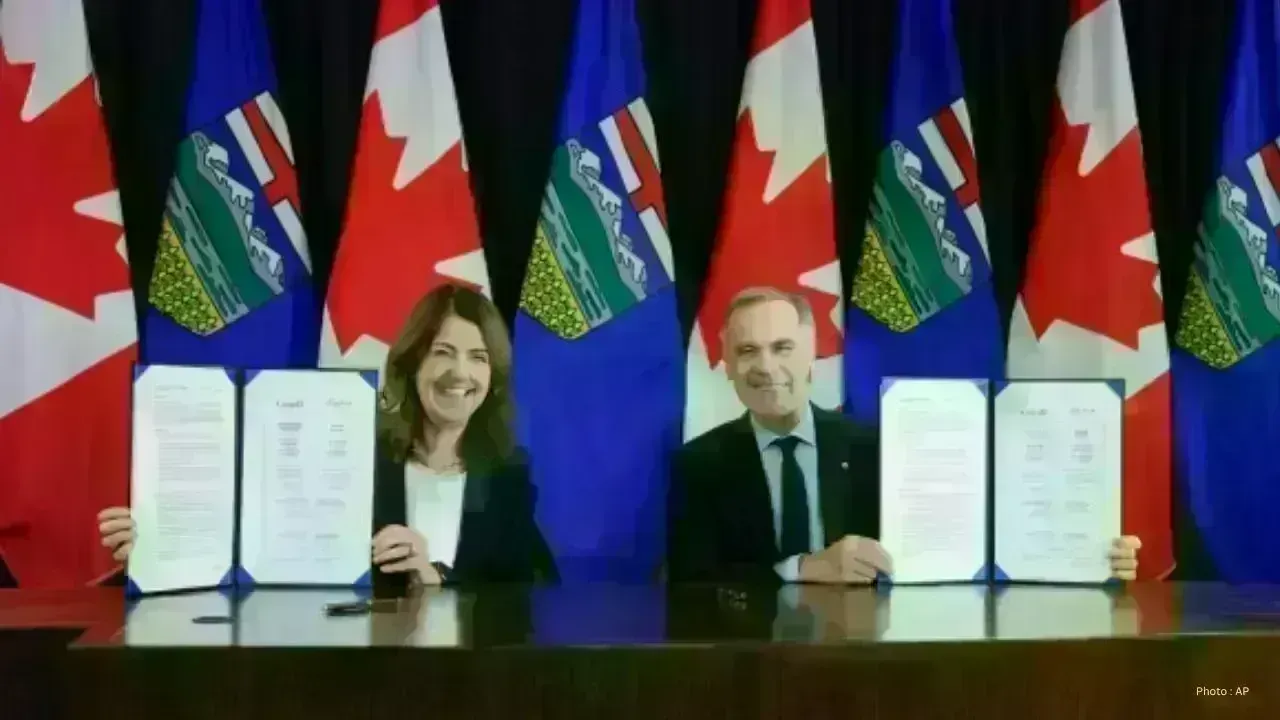
Insiders reveal that Prime Minister Mark Carney plans to visit Calgary to formally unveil the details alongside Alberta Premier Danielle Smith. These negotiations are seen as a crucial political compromise balancing Ottawa’s environmental aspirations with the concerns of Alberta’s oil and gas sector.
The suggested framework proposes that Alberta’s current industrial carbon pricing, presently around C$95 per tonne, will rise to C$100 per tonne next year and will continue to increase gradually until it reaches C$130 per tonne by 2040, before escalating by approximately 1.5 percent each year thereafter. Industry leaders and provincial officials argue that this tempered approach will enable Canadian energy firms to remain internationally competitive while promoting long-term emissions reductions.
This agreement follows Alberta's decision to freeze its industrial carbon pricing system in 2025. Experts have raised concerns since then that the prevailing market price for industrial carbon credits has plummeted too low to incentivize investments in cleaner technologies. Presently, carbon credits in Alberta are trading between C$20 and C$40 per tonne, significantly lower than the thresholds many environmental specialists deem necessary for significant emissions reductions.
Federal representatives assert that this new arrangement could also pave the way for key energy infrastructure projects, including Alberta’s proposed crude oil pipeline directed towards British Columbia’s northwest coast. Ottawa has previously suggested that the granting of approvals for large pipeline expansions would largely rely on energy companies making more substantial commitments towards carbon reduction initiatives, such as carbon capture and storage technologies.
However, environmental advocates quickly criticized the slower timeline as soon as details of the proposed deal surfaced. Climate proponents had been advocating for the C$130-per-tonne target to be achieved by 2030 instead of 2040. Detractors contend that postponing more robust carbon pricing undermines Canada’s climate goals and diminishes the pressure on significant polluters to promptly reduce emissions.
Online discourse surrounding this agreement has also sparked debate. On platforms like Reddit and social media, a number of Canadians have voiced concerns that the new plan overly favors Alberta’s oil industry. Some participants warn that the slower escalations could hinder genuine climate action, while others defend the compromise as essential for safeguarding employment, investment, and Canada's energy exports amid fluctuating global economic conditions.
Political analysts highlight that these negotiations underscore the challenging equilibrium Ottawa must achieve between environmental policies and economic advancement. Alberta is Canada’s largest oil-producing province, and ongoing tensions regarding carbon pricing have fueled conflicts between federal and provincial governments. Prime Minister Carney’s administration appears to pursue a balanced approach that promotes industrial expansion while adhering to some form of long-term emissions reduction framework.
If finalized, this agreement could emerge as one of the most pivotal climate-policy compromises in Canada since the initial introduction of the federal carbon pricing system. Nevertheless, it is expected that environmental groups, industry leaders, and provincial governments will persist in debating whether the strategy strikes the right balance in addressing both economic and environmental challenges.










Meta Unveils Subscription Plans for Instagram, Facebook, and WhatsApp
Meta introduces new subscription plans for users of Instagram, Facebook, and WhatsApp, featuring enh

Suvarna Joy on Education Leadership, Resilience, and Building Purpose Through Adversity in the UAE
Suvarna Joy shares her journey of education leadership, motherhood, faith, and resilience within the

Anticipated Dates for UAE Eid Al Adha 2026 Unveiled by Astronomical Experts
Experts predict Eid Al Adha 2026 in the UAE to start on May 27, prompting early holiday planning amo

DAE Achieves Remarkable Growth in Q1 2026 With Record Revenue
Dubai Aerospace Enterprise announces impressive financial results for Q1 2026, reflecting a surge in

Price Increase for Sony PS5 in Southeast Asia Effective May 1
Sony announces a price increase for the PS5 across Southeast Asia starting May 1, 2026, impacting ga

Potential ‘Super El Niño’ in 2026: Understanding the Climate Risks
Could a Super El Niño emerge in 2026? Discover its implications and potential global climate impacts




