Post by : Anees Nasser
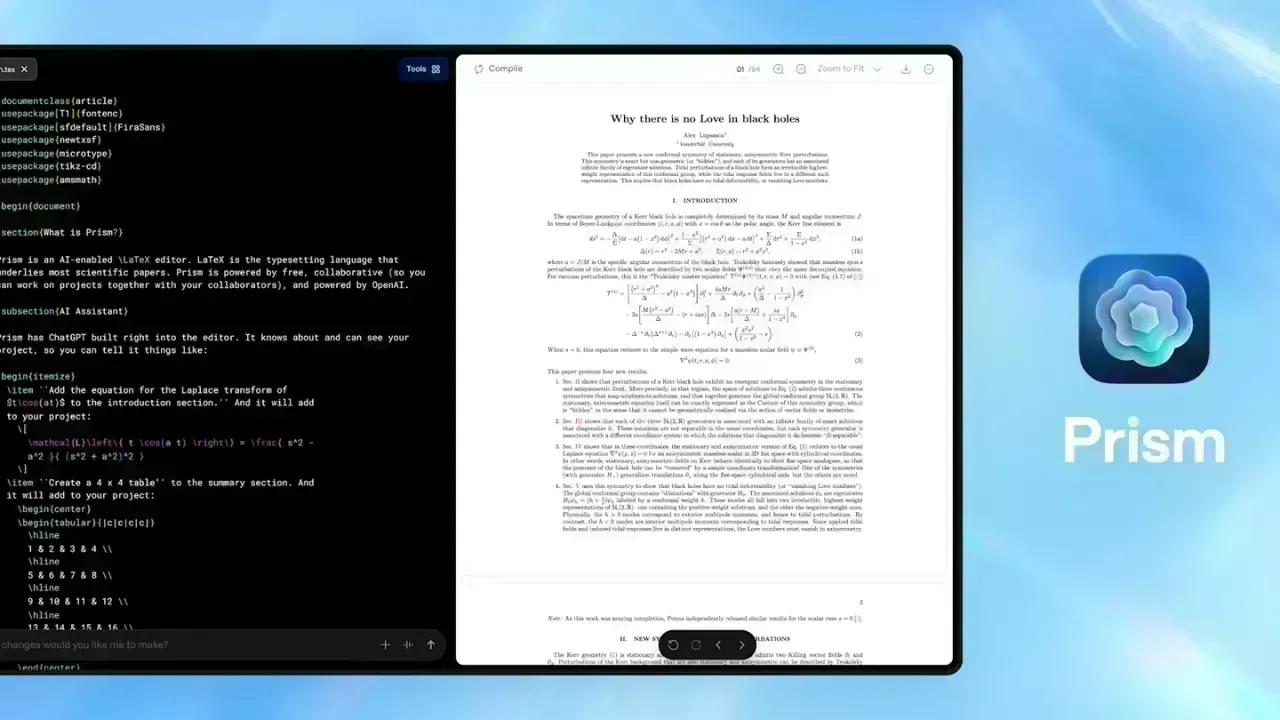
OpenAI has launched Prism, a cutting-edge AI workspace tailored for scientific writing and collaboration. Recognized as an AI-first platform, Prism marks a transformative change in how researchers draft and share scientific documents, from manuscripts to research papers. Powered by OpenAI’s latest GPT-5.2 model, it integrates deep reasoning capabilities with LaTeX, the preferred formatting language in academia. This launch is set to revolutionize the scientific writing process by combining drafting, citation management, real-time collaboration, and advanced AI support in a single platform.
Unlike conventional research tools that tackle separate aspects of the scientific writing process, Prism merges these functionalities into a cloud-based workspace accessible from any location. It strives to reduce the hassle of switching platforms and the manual formatting that often hampers scientific progress. Available to anyone with a personal ChatGPT account and soon to be accessible to enterprise users, Prism is offered free of charge with no limits on collaborators or projects, making it an invaluable resource for scientists at all stages of their careers.
Historically, scientific research processes have been disjointed. Many researchers find themselves dedicating more time to managing citations, formatting documents, or coordinating collaborative edits than advancing the scientific content itself. Writing research manuscripts frequently requires managing several tools: version control systems, reference managers, text editors, equation editors, and file hosting platforms. Even sophisticated tools for individual tasks often lack seamless integration, leading to increased cognitive load and decreased efficiency for teams.
A typical scientific article endures multiple revisions and edits, often involving numerous collaborators across diverse institutions and time zones. Challenges such as real-time co-editing, change tracking, comment integration, and managing different versions proliferate. Furthermore, composing complex elements like equations, tables, figures, and citations with traditional tools contributes to substantial time spent on manual formatting. This landscape has paved the way for AI-powered solutions like Prism, aimed at streamlining essential workflows in scientific research.
At its core, Prism is a cloud-enabled LaTeX workspace seamlessly integrating advanced AI with the traditional framework of scientific writing. LaTeX is widely adopted in STEM fields due to its adept handling of equations, tables, figures, and formatting necessities, making it the go-to choice for academic paper drafting. Prism incorporates this environment in a cloud-based format while embedding AI features that comprehend the complete context of an ongoing manuscript.
A key benefit of Prism lies in its AI-facilitated drafting and revision capabilities. Leveraging GPT-5.2, the tool assists users in tasks such as summarizing sections, enhancing clarity and precision, pinpointing necessary citations, translating sketches or handwritten formulas into LaTeX code, and recommending structural improvements. The AI also enables users to explore concepts, work through intricate issues, and adapt content dynamically in response to user feedback.
Prism’s project-aware AI retains a comprehensive history of a manuscript, including prior drafts and revisions, which enhances contextual suggestions and editing accuracy. For example, while enhancing a discussion section, the AI references previous sections, avoiding isolated treatment. Such capabilities mitigate repetitive manual checks for consistency throughout a manuscript.
One of Prism's standout features is its allowance for unlimited collaborators, permitting research teams of any size to collaborate in real-time without limitations or extra costs. This addresses significant barriers in collaborative research, where traditional editing-and-sharing models often restrict access, leading to version conflicts and workflow disruptions. Within Prism, collaborators can view edits, comments, and annotations live, minimizing miscommunications and ensuring that all contributors work with the latest document version.
The capacity for unlimited projects and collaborators offers flexibility for research teams that span various institutions, disciplines, and geographical areas. Graduate students, mentors, co-authors, and external evaluators can join the writing endeavor without facing licensing or permission limitations typically encountered in paid environments. By removing such obstacles, Prism seeks to democratize access to quality research tools, encouraging an inclusive collaborative atmosphere.
LaTeX has long been the benchmark for scientific typesetting, boasting precise content formatting and the capacity for complex mathematical expressions. Prism’s deep integration with LaTeX—directly incorporated into the workspace—eliminates the need for separate LaTeX installations or offline editing systems. Prism manages compilation, formatting, and previews automatically, supplying a real-time document rendering without the delays or technical burdens of conventional LaTeX workflows.
Beyond standard LaTeX features, Prism enhances functionality with options like equation conversion, citation management, and automated error-checking, significantly alleviating the manual workload. Instead of hunting for formatting errors or broken references, the AI aids in identifying and rectifying these issues throughout the drafting process. This combined approach maintains the rigor of LaTeX formatting while markedly improving usability for scientists less versed in LaTeX.
Although Prism is primarily aimed at drafting and formatting scientific materials, its AI-support features extend its functionality far beyond simple text editing. Researchers can utilize the platform to clarify complex arguments, refine hypotheses, confirm logical soundness, or search and incorporate relevant literature. Unlike standard text editors, Prism’s AI grasps the semantic context of scientific claims, providing suggestions that resonate within the greater narrative of the manuscript.
The platform's capability to facilitate literature searches right within the workspace enables users to uncover and integrate citations without the need to switch tools. This simplifies the often tedious task of locating and formatting references. Additionally, Prism’s reasoning abilities allow scientists to conceptualize ideas and evaluate relationships—like contrasting competing models or verifying logical consistency between hypotheses and outcomes.
OpenAI has made Prism accessible to students, independent researchers, and seasoned scientists alike, requiring only a ChatGPT personal account for basic access. This approach mitigates traditional barriers linked to paywalls, subscription fees, and institutional licenses. By promoting early access, Prism positions itself to serve as a potential equalizer in the academic field, empowering smaller or underfunded teams with advanced scientific writing and collaboration tools that were once limited to those with paid subscriptions.
The company further plans to extend organizational access—including business, enterprise, and educational plans—facilitating broader institutional acceptance of Prism's capabilities on a grand scale. By supporting individual creativity alongside extensive team collaboration, this platform aims to cater to the complete range of academic users and research experts.
Prism arrives at a critical moment when AI-driven technologies are increasingly shaping scientific exploration, publication scheduling, and interdisciplinary cooperation. As research output escalates globally, the demand for tools that ease the manuscript preparation and collaborative processes comes into sharper focus. Academic publishers, research institutions, and individual scholars alike are likely to find value in Prism’s singular workspace, especially as it reduces the need for juggling multiple software and data systems.
In addition to manuscript drafting, Prism’s reasoning capabilities could accelerate iterative thought processes and refine hypotheses, potentially abbreviating the timeline between experimentation and publication. By providing a platform that minimizes redundant administrative tasks, scientists can direct their attention to core intellectual challenges, enhance conceptual exploration, and stimulate innovation.
Every revolutionary tool invites scrutiny, and Prism is not an exception. Some critics highlight that while Prism excels in writing and formatting tasks, it does not supersede the deeper, domain-specific analytical processes fundamental to scientific inquiry. Researchers will continue to need to conduct experiments, analyze data, and make judgments about findings—areas where AI tools provide assistance but do not independently execute.
Looking to the future, later versions of Prism might incorporate more sophisticated features like automatic data visualization, deeper semantic searches across scientific literature repositories, or integrations with experimental design platforms. These possibilities hint at ongoing development towards more comprehensive research ecosystems capable of supporting the full scientific discovery lifecycle, beyond just writing and formatting.
The unveiling of Prism by OpenAI signifies an important advance in integrating artificial intelligence into scientific research processes. By offering a cohesive space for writing, collaboration, formatting, citation management, and sophisticated AI support—all fueled by the capabilities of GPT-5.2—Prism delivers a game-changing alternative to classic research tools. Its no-cost availability and model for unlimited collaboration democratize access, potentially enabling a wider array of researchers globally to contribute to advancements in science.
With Prism, OpenAI isn’t merely launching a tool; it’s initiating a transformation in how scientific ideas are documented, honed, and disseminated. As its adoption expands, Prism may significantly impact the pace of scientific writing, interdisciplinary teamwork, and innovation across varied fields.
Disclaimer: This article reflects information currently available from public reporting and official announcements at the time of writing. It is provided solely for informational purposes and should not be construed as technical or professional advice.










DAE Achieves Remarkable Growth in Q1 2026 With Record Revenue
Dubai Aerospace Enterprise announces impressive financial results for Q1 2026, reflecting a surge in

Price Increase for Sony PS5 in Southeast Asia Effective May 1
Sony announces a price increase for the PS5 across Southeast Asia starting May 1, 2026, impacting ga

Potential ‘Super El Niño’ in 2026: Understanding the Climate Risks
Could a Super El Niño emerge in 2026? Discover its implications and potential global climate impacts

Global Energy Crisis Intensifies: Markets React to Oil Supply Challenges
Markets are on edge as oil disruptions escalate, influencing prices and economic stability. Explore

Must-See Tourist Spots in London You Can't Overlook
Explore London's essential attractions, from royal landmarks to vibrant markets, ensuring an unforge

Ultimate Guide to Snagging Cheap Flights in 2026
Unlock the secrets to booking affordable flights in 2026 with insightful tips and strategies tailore




