Post by : Shweta
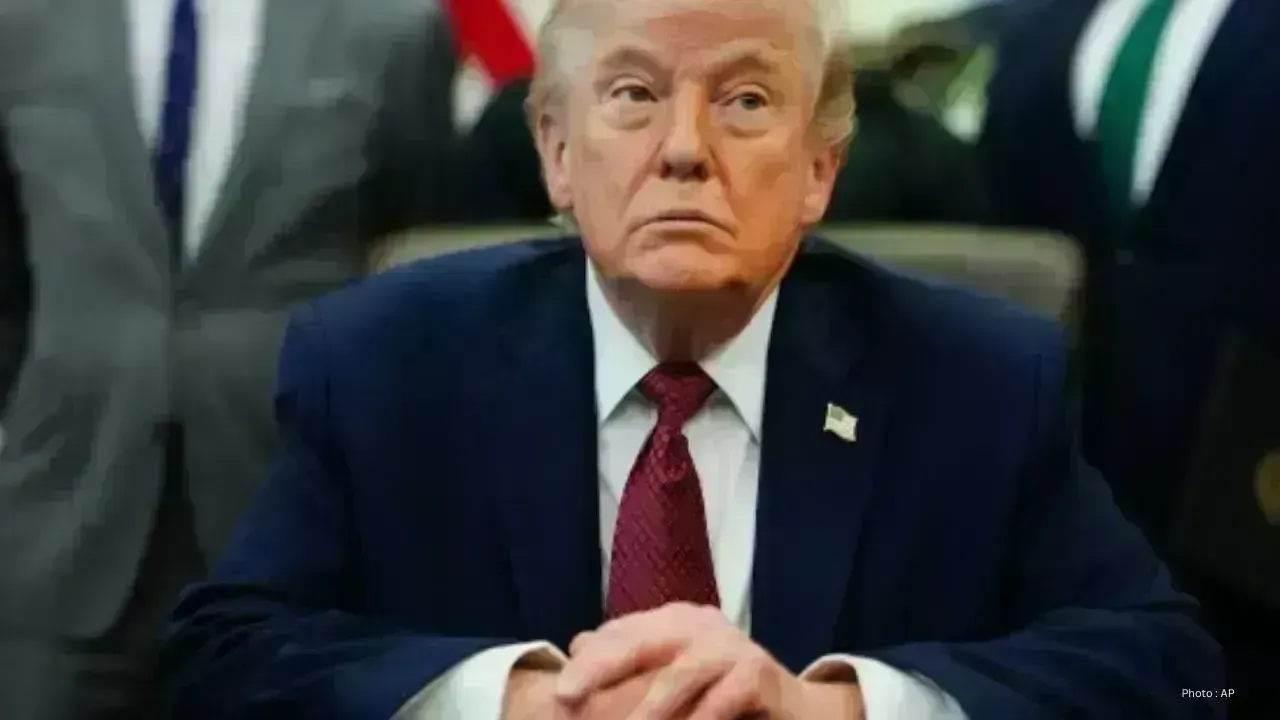
A significant report from the U.S. Congressional Budget Office has raised alarms regarding President Donald Trump’s ambitious “Golden Dome” missile defense initiative, forecasting a staggering $1.2 trillion cost over the next two decades while still lacking full protection against extensive missile attacks. The findings have sparked heated discussions in Washington about the financial implications, feasibility, and defense value of one of Trump's hallmark military projects.
The Golden Dome was proposed by Trump shortly after his 2025 inauguration, drawing inspiration from Israel’s Iron Dome but designed to be massively more sophisticated. This American system aims to identify, monitor, and neutralize ballistic, hypersonic, and cruise missiles prior to impact on U.S. soil. It combines ground interceptors, advanced radar technology, and an extensive network of satellites in orbit.
Initially estimated by Trump to require around $175 billion to implement within several years, the Congressional Budget Office now indicates that the final price tag may soar nearly sevenfold. The bulk of the expenditures will reportedly be invested in establishing and maintaining a colossal array of approximately 7,800 space-based interceptor satellites intended to eliminate enemy projectiles mid-flight.
Despite the extensive projected investment, analysts caution that the Golden Dome may not adequately defend against a comprehensive assault from major nuclear powers like Russia or China. They suggest that while the system could be effective against sporadic missile launches from nations such as North Korea, it may not withstand a full-scale coordinated attack featuring numerous advanced missiles.
Experts in military technology have also expressed skepticism regarding the capability of current technologies to ensure the project's overall success. Intercepting hypersonic missiles, with their remarkable speeds and agile flight capabilities, poses an enormous challenge to modern defense frameworks. Several defense analysts indicate that a fully reliable protective shield encompassing the entire United States would likely necessitate technology and infrastructure that are not yet developed on a substantial scale.
Domestically, the proposal is a hotly debated subject. Supporters, mainly Republican leaders aligned with Trump, argue that the increasing missile threats from China, Russia, Iran, and North Korea underscore the project’s necessity for national safety. Trump consistently contends that the U.S. must brace for “next-generation threats” and safeguard itself against modern missile warfare.
On the contrary, critics, primarily from the Democratic faction as well as watchdogs of government expenditure, argue that this plan could mutate into one of the costliest military undertakings in U.S. history, largely benefiting major defense contractors. Senator Jeff Merkley has publicly denounced the endeavor as a substantial financial strain on taxpayers, with corporations like Lockheed Martin, Boeing, Northrop Grumman, and RTX Corporation anticipated to vie for substantial contracts related to the initiative.
The Pentagon has initiated preliminary development phases for elements of the Golden Dome initiative, including significant contracts awarded by the U.S. Space Force aimed at researching space-based missile interception technologies. Trump has advocated for the system to be up and running before the close of his current term, whereas many specialists believe that such timelines are overly optimistic, given the inherent technical and fiscal hurdles.
Security specialists express concerns that the Golden Dome project may escalate tensions with rival nations and potentially instigate a new global arms competition in space. Russia and China have both previously critiqued U.S. endeavors regarding space weaponry, positing that such initiatives could undermine international security. Some experts worry that nations might respond by developing more sophisticated missiles or counter-space technologies targeting the Golden Dome system.





Anticipated Dates for UAE Eid Al Adha 2026 Unveiled by Astronomical Experts
Experts predict Eid Al Adha 2026 in the UAE to start on May 27, prompting early holiday planning amo

DAE Achieves Remarkable Growth in Q1 2026 With Record Revenue
Dubai Aerospace Enterprise announces impressive financial results for Q1 2026, reflecting a surge in

Price Increase for Sony PS5 in Southeast Asia Effective May 1
Sony announces a price increase for the PS5 across Southeast Asia starting May 1, 2026, impacting ga

Potential ‘Super El Niño’ in 2026: Understanding the Climate Risks
Could a Super El Niño emerge in 2026? Discover its implications and potential global climate impacts

Global Energy Crisis Intensifies: Markets React to Oil Supply Challenges
Markets are on edge as oil disruptions escalate, influencing prices and economic stability. Explore

Must-See Tourist Spots in London You Can't Overlook
Explore London's essential attractions, from royal landmarks to vibrant markets, ensuring an unforge




