Post by : Raina Nasser
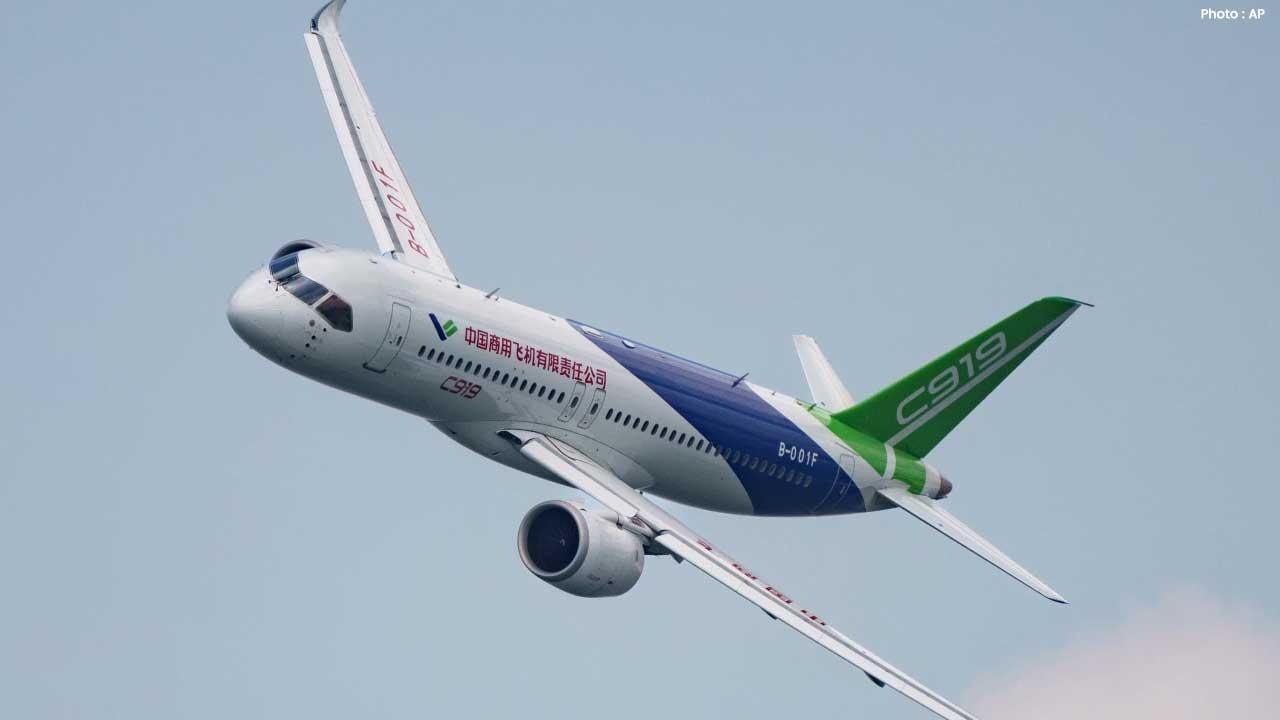
China’s attempt to compete with Boeing and Airbus via the domestically developed C919 is encountering material setbacks as rising tensions with the United States threaten key supply lines and delivery schedules. The C919, produced by state-owned COMAC, celebrated a first commercial appearance in 2023 but now faces a far more complex path to scaling production.
Although intended as a national flagship, the C919 depends extensively on components sourced abroad. The programme relies on roughly 48 major American suppliers and many more from Europe, leaving production vulnerable to export curbs. Recent policy frictions have complicated procurement of critical subsystems such as avionics and powerplants.
Industry analysts warn of pronounced supply-chain exposure. "The programme is vulnerable to export restrictions and geopolitical bargaining," said Max Zenglein, senior economist at The Conference Board. In particular, the LEAP-1C engine—co-developed by GE Aerospace and Safran—requires U.S. export approvals, a clearance process that was temporarily halted earlier this year and disrupted assembly timelines.
Progress on the ground remains uneven. COMAC had signalled plans to deliver 30 aircraft by 2025, yet only seven units have been handed over so far this year, while major Chinese carriers—Air China, China Eastern and China Southern—operate roughly 20 C919s collectively. These figures underscore the difficulty of ramping up while meeting international safety and quality benchmarks.
Experts say structural challenges extend beyond production. "To be a genuine global competitor the C919 needs viable economics, international support networks and certification from major regulators," commented Richard Aboulafia, managing director of AeroDynamic Advisory. Without approvals from Western authorities such as the FAA or EASA, the type’s operations remain largely confined to Chinese airspace.
Meanwhile, Airbus is expanding capacity in China, planning a second A320 assembly line by 2026 to meet domestic demand. Analysts forecast that COMAC may consolidate its position at home in the late 2020s, but dislodging the Boeing-Airbus duopoly worldwide will take years—and overcoming export-control constraints is the most immediate obstacle.
Beijing continues to prioritise the project as a marker of industrial autonomy. The C919 is as much a statement about national technological ambition as it is an airliner, and global observers will be watching whether the programme can overcome supply restraints and regulatory hurdles to achieve broader international reach.










DAE Achieves Remarkable Growth in Q1 2026 With Record Revenue
Dubai Aerospace Enterprise announces impressive financial results for Q1 2026, reflecting a surge in

Price Increase for Sony PS5 in Southeast Asia Effective May 1
Sony announces a price increase for the PS5 across Southeast Asia starting May 1, 2026, impacting ga

Potential ‘Super El Niño’ in 2026: Understanding the Climate Risks
Could a Super El Niño emerge in 2026? Discover its implications and potential global climate impacts

Global Energy Crisis Intensifies: Markets React to Oil Supply Challenges
Markets are on edge as oil disruptions escalate, influencing prices and economic stability. Explore

Must-See Tourist Spots in London You Can't Overlook
Explore London's essential attractions, from royal landmarks to vibrant markets, ensuring an unforge

Ultimate Guide to Snagging Cheap Flights in 2026
Unlock the secrets to booking affordable flights in 2026 with insightful tips and strategies tailore




