Post by : Naveen Mittal
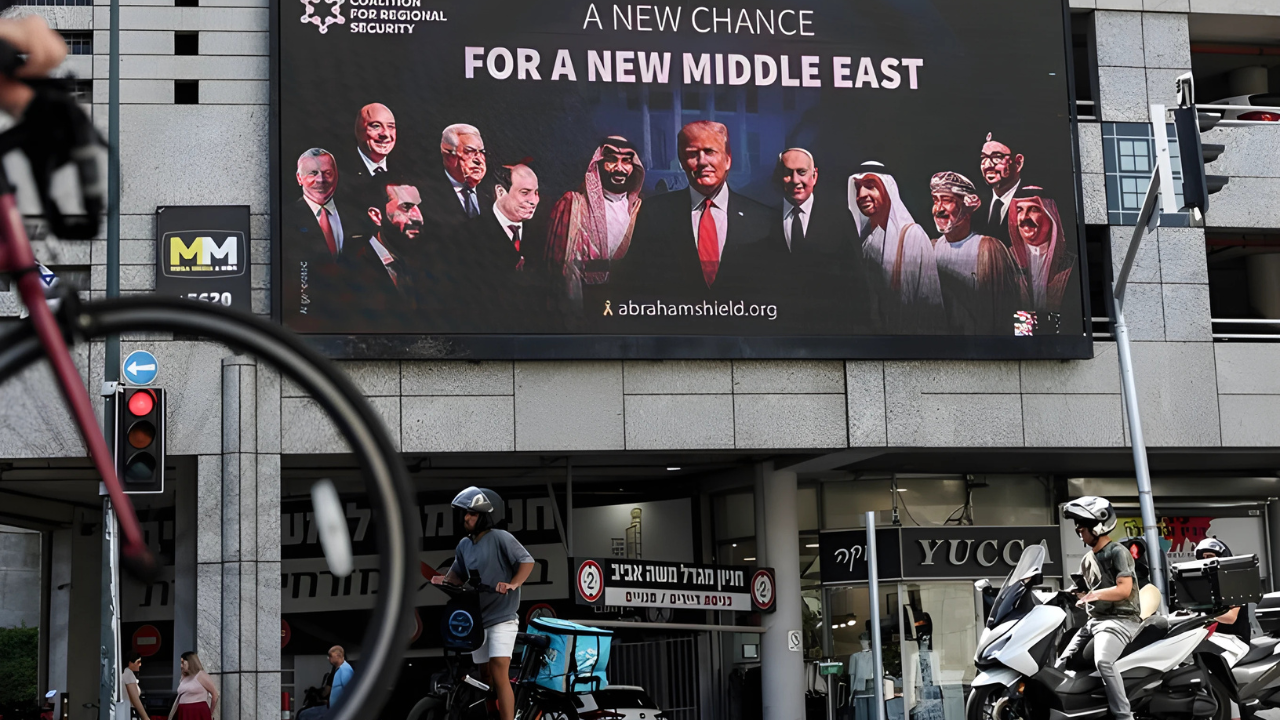
The Abraham Accords are a group of peace and normalisation agreements signed between Israel and several Arab states beginning in 2020. They marked one of the most important diplomatic shifts in the Middle East in recent decades, as Arab nations formally recognised Israel after years of refusing to do so without a Palestinian state.
The first signatories were the United Arab Emirates (UAE) and Bahrain, who signed the agreements at the White House in Washington during the presidency of Donald Trump. It was the first time in 25 years that Arab nations officially recognised Israel. Later, Morocco and Sudan also joined the accords, bringing the number of Arab participants to four.
The accords were named after the prophet Abraham, a figure respected by Jews, Christians, and Muslims, as a symbol of unity between the faiths.
The accords were strongly backed by the U.S. government. Jared Kushner, the son-in-law and adviser of President Trump, played a leading role in brokering the negotiations. The Trump administration presented the agreements as a major diplomatic breakthrough that could bring long-term peace to the Middle East.
For Israel, the biggest prize was the agreement with the United Arab Emirates. The UAE is not only a wealthy oil producer but also a global hub for trade, finance, and travel. Establishing formal ties opened the door to investment, security cooperation, and technology exchange between the two countries.
Since signing, Israel and the UAE have developed close economic and security relations. They signed a free trade agreement and began joint projects in defence, health, tourism, and innovation. Direct flights started between Tel Aviv and Dubai, making travel and business easier than ever.
Bahrain, Morocco, and Sudan also improved ties with Israel, although not to the same level as the UAE. For Morocco, recognition brought benefits such as U.S. support for its territorial claims in Western Sahara. Sudan hoped for removal from the U.S. list of state sponsors of terrorism, which it eventually achieved.
While the Abraham Accords were praised by Washington and Israel, Palestinians felt deeply betrayed. For decades, Arab states had promised not to make peace with Israel until Palestinians achieved statehood and independence.
By signing the accords without progress on a Palestinian state, the Arab countries broke with that long-standing position. Palestinian leaders accused their Arab neighbours of abandoning them.
Although the accords created new opportunities, tensions have grown in recent years. One major issue is Israel’s expansion of settlements in the occupied West Bank.
The UAE warned Israel that annexation of West Bank territory would cross a red line and destroy the spirit of the accords. Far-right members of Israel’s government openly reject the idea of a Palestinian state and push for more settlement building, causing friction with Arab partners.
The Gaza war that began in October 2023 also placed enormous strain on the accords. After Hamas militants attacked Israel, Israel launched a military campaign in Gaza that killed tens of thousands of Palestinians. This sparked outrage across the Arab world and increased public anger toward Israel.
As a result, Arab states that signed the accords have found it harder to openly cooperate with Israel, even if formal ties remain in place.
The United States continues to see the Abraham Accords as a cornerstone of its Middle East policy. Both former President Joe Biden and President Trump since his return to office in 2025 have promoted expanding the accords to include more countries.
Washington’s biggest goal has been to convince Saudi Arabia, the most powerful Arab state, to join the accords. However, Saudi leaders have made it clear that they will not normalise relations with Israel without progress toward creating a Palestinian state.
Other countries have been discussed as possible new members. U.S. officials have explored bringing in Azerbaijan and some Central Asian nations, which are mostly Muslim but not Arab. This would further strengthen Israel’s diplomatic and trade ties beyond the Middle East.
Donald Trump, who oversaw the signing of the original accords, has continued to champion them. He recently said that adding more countries would ensure peace and stability in the region.
His administration is now holding talks with Azerbaijan and allies in Central Asia about joining. According to sources familiar with the discussions, the aim is to deepen ties between Israel and Muslim-majority states that may not be directly involved in the Palestinian conflict.
Despite challenges, the Abraham Accords remain historic. They showed that some Arab states were willing to put aside decades of hostility and cooperate with Israel in areas like trade, technology, energy, and defence.
The accords also revealed a major shift in priorities for some Arab governments. Instead of waiting for a solution to the Palestinian conflict, they focused on national interests like security against Iran, access to advanced technology, and economic growth.
For Israel, the accords ended its isolation in parts of the Arab world and gave it recognition from important neighbours. For the U.S., they represented a rare diplomatic success in a region often dominated by conflict.
The biggest obstacle remains the unresolved Palestinian issue. As long as Palestinians do not have a state, many Arabs see normalisation as unjust. Wars like the one in Gaza make cooperation even more difficult, as public anger across the Middle East grows.
Still, leaders in Washington, Tel Aviv, and some Arab capitals believe the accords can survive these challenges. They argue that cooperation on trade, investment, and security can eventually lay the foundation for broader peace.
Whether the accords expand or collapse depends on how Israel manages its conflict with the Palestinians, how Arab leaders respond to public opinion, and how much pressure or incentives the United States offers.
The Abraham Accords reshaped the Middle East by breaking a 25-year freeze on Arab-Israeli peace deals. Signed by the UAE, Bahrain, Morocco, and Sudan, they opened the door to cooperation and economic growth.
But the accords also deepened divisions with Palestinians, strained under war in Gaza, and remain fragile. Their future now depends on whether new countries, especially Saudi Arabia, will join and whether Israel can address the issue of Palestinian statehood.
For now, they stand as both a historic breakthrough and a fragile experiment in Middle Eastern diplomacy.









Anticipated Dates for UAE Eid Al Adha 2026 Unveiled by Astronomical Experts
Experts predict Eid Al Adha 2026 in the UAE to start on May 27, prompting early holiday planning amo

DAE Achieves Remarkable Growth in Q1 2026 With Record Revenue
Dubai Aerospace Enterprise announces impressive financial results for Q1 2026, reflecting a surge in

Price Increase for Sony PS5 in Southeast Asia Effective May 1
Sony announces a price increase for the PS5 across Southeast Asia starting May 1, 2026, impacting ga

Potential ‘Super El Niño’ in 2026: Understanding the Climate Risks
Could a Super El Niño emerge in 2026? Discover its implications and potential global climate impacts

Global Energy Crisis Intensifies: Markets React to Oil Supply Challenges
Markets are on edge as oil disruptions escalate, influencing prices and economic stability. Explore

Must-See Tourist Spots in London You Can't Overlook
Explore London's essential attractions, from royal landmarks to vibrant markets, ensuring an unforge




