Post by : Priya
Photo:Reuters
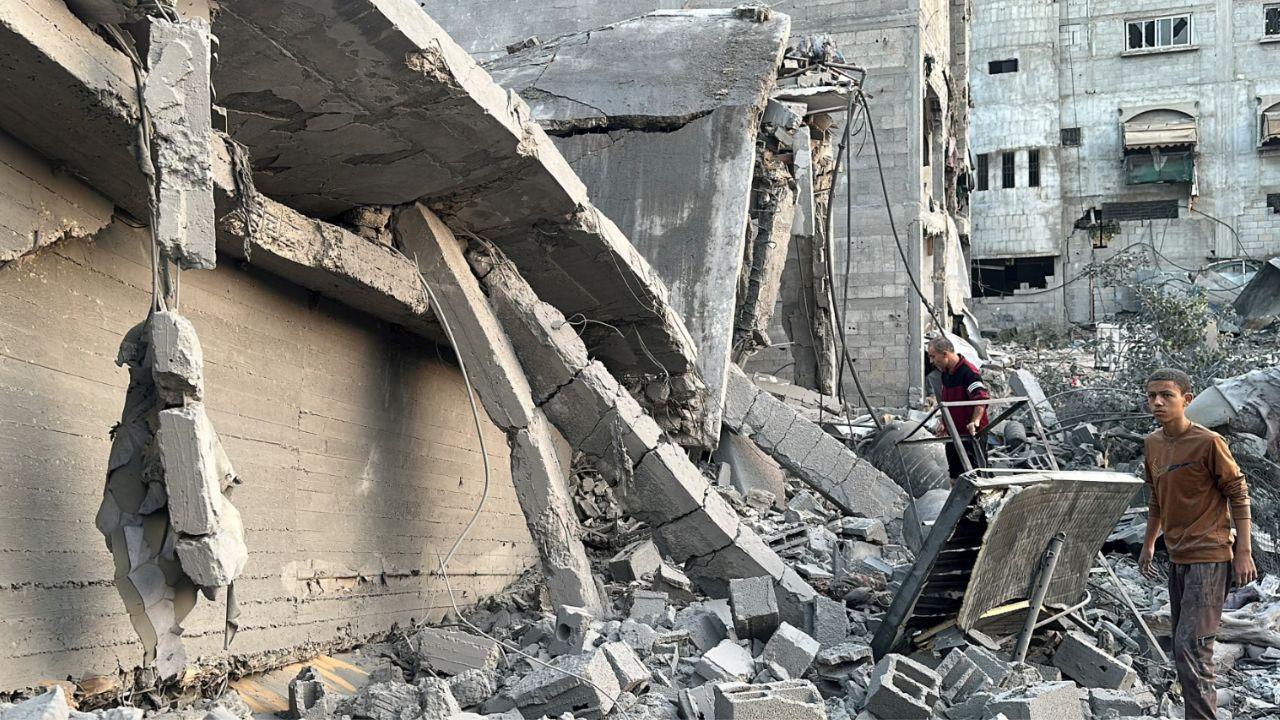
In another tragic development in the ongoing conflict between Israel and the Gaza Strip, at least six civilians lost their lives after Israeli airstrikes hit residential areas in central and southern Gaza. The latest attacks were reported by Gaza’s Civil Defense Authority, which said its teams pulled six bodies from the rubble following overnight bombings.
This incident adds to the growing humanitarian crisis in Gaza and comes at a time when hopes for a ceasefire remain slim. The strikes have drawn concern from local and international observers, while families continue to face death, displacement, and despair.
What Happened?
The Airstrikes
In the early hours of July 11, 2025, the Israeli military carried out a new round of airstrikes on the Gaza Strip, targeting what it called “terror infrastructure.” However, local officials say the attacks struck densely populated areas where civilians live.
According to Mahmoud Basal, spokesperson for Gaza’s Civil Defense, four people were killed in Deir al-Balah when a house was flattened in the Al-Zawaida neighborhood. Two more died in Khan Younis, where air raids destroyed multiple homes and left several wounded.
Eyewitnesses reported hearing powerful explosions that shook the ground and saw entire families fleeing their homes in fear. Some residents described the scenes as "hellish" with smoke, fire, and cries for help filling the night air.
Rescue Efforts
Civil defense teams worked tirelessly under dangerous conditions to rescue those trapped beneath the debris. Many injured civilians were taken to already overwhelmed hospitals, while bodies were placed in makeshift morgues.
“The destruction is massive. Families were sleeping. Children were in their beds. Now they're gone,” one rescue worker said with tears in his eyes.
Life in Gaza – A Daily Struggle
Humanitarian Crisis Deepens
Gaza’s humanitarian situation has been deteriorating for years, and each new airstrike worsens an already critical environment. Over 2 million people live in Gaza, most of them under blockade and with limited access to basic services like clean water, food, electricity, and healthcare.
Hospitals are functioning with limited medicine and fuel, often relying on donations and emergency aid from international organizations. Doctors have repeatedly warned that the health system is on the verge of collapse.
Daily Life in a War Zone
Children in Gaza wake up every day unsure if they’ll survive the next round of fighting. Schools have been turned into shelters. Families often huddle together at night, praying the bombs won’t hit their homes.
For most people, survival means standing in long lines for water, bread, or fuel. Power cuts last for 20 hours a day. Parents send their children to school, not knowing if they will return.
“The fear is constant,” said Umm Ibrahim, a mother of five. “We try to protect our children, but how do you protect them from the sky?”
The Military Perspective
What Israel Says
The Israeli government has defended its actions by saying the strikes are aimed at eliminating terrorist threats, specifically targeting Hamas infrastructure and militants. Israel claims that Hamas uses residential areas as cover, storing weapons and operating command centers in civilian buildings.
However, critics say that this strategy puts too many civilians in harm's way. Videos shared on social media and by local reporters show entire buildings leveled with no visible signs of military activity nearby.
Hamas and Armed Groups
Hamas, which governs the Gaza Strip, often responds to Israeli attacks with rocket fire into Israeli territory. In most cases, Israel's Iron Dome defense system intercepts the rockets. Still, the back-and-forth attacks keep the region in a constant state of tension.
Both sides blame each other for civilian casualties. Hamas accuses Israel of targeting innocent people, while Israel accuses Hamas of endangering lives by operating in civilian areas.
The International Reaction
Condemnations and Calls for Restraint
The latest airstrikes have drawn global attention. The United Nations, the European Union, and several Arab nations have expressed concern over the rising death toll and damage to civilian infrastructure.
UN Secretary-General António Guterres issued a statement urging both sides to “show maximum restraint” and to “prioritize the protection of civilians in accordance with international law.”
Human rights organizations, including Amnesty International and Human Rights Watch, have also condemned the attacks, calling for independent investigations into possible violations of humanitarian law.
The United States and the Role of Mediation
The United States, a close ally of Israel, has continued to call for calm while expressing support for Israel’s right to defend itself. At the same time, U.S. officials have encouraged both sides to return to the negotiating table.
Egypt and Qatar have taken the lead in trying to mediate a new ceasefire agreement. Talks are ongoing but have seen little progress in recent weeks due to deep mistrust on both sides.
Stories Behind the Numbers
The Victims
Each death in Gaza is not just a statistic; it's a human life. The six people killed in the recent airstrikes include a father, his two daughters, and a newly married couple. Their stories are painful reminders of the real cost of war.
One of the victims, 9-year-old Salma, was reportedly asleep in bed when the missile hit. Her body was found under the collapsed ceiling, still holding her favorite toy.
“She was full of dreams,” her uncle said. “Now she’s gone. Just like that.”
Families Torn Apart
Survivors often face a lifetime of trauma. Many children have lost parents, and many parents have lost all their children. The psychological scars will last long after the physical wounds heal.
Mental health support is nearly nonexistent in Gaza. Most survivors carry their pain in silence.
A Cycle Without End?
A History of Conflict
The Gaza-Israel conflict has gone on for decades, with multiple wars and countless flare-ups. Each time violence erupts, innocent lives are lost, and the region is pushed further from peace.
Despite international efforts, a lasting solution remains elusive. Political divisions, mistrust, and unresolved grievances continue to block progress.
The Cost of Inaction
If the world continues to look away, the human cost will only grow. Children will keep dying. Families will keep suffering. The hope for peace will keep fading.
As one Gaza resident put it: “We are not just headlines. We are people. We deserve to live.”
What Needs to Happen
Immediate Ceasefire
The first and most urgent need is an immediate and lasting ceasefire. Continued violence only fuels hatred and causes more suffering.
A halt to hostilities will allow aid organizations to reach those in need, give hospitals a chance to recover, and offer civilians a moment of safety.
Long-Term Political Solutions
True peace requires more than a temporary truce. It needs bold leadership, honest dialogue, and international cooperation.
Both Israel and the Palestinian leadership must commit to meaningful negotiations. The international community must support efforts for a two-state solution, with equal rights and safety for both peoples.
Justice and Accountability








DAE Achieves Remarkable Growth in Q1 2026 With Record Revenue
Dubai Aerospace Enterprise announces impressive financial results for Q1 2026, reflecting a surge in

Price Increase for Sony PS5 in Southeast Asia Effective May 1
Sony announces a price increase for the PS5 across Southeast Asia starting May 1, 2026, impacting ga

Potential ‘Super El Niño’ in 2026: Understanding the Climate Risks
Could a Super El Niño emerge in 2026? Discover its implications and potential global climate impacts

Global Energy Crisis Intensifies: Markets React to Oil Supply Challenges
Markets are on edge as oil disruptions escalate, influencing prices and economic stability. Explore

Must-See Tourist Spots in London You Can't Overlook
Explore London's essential attractions, from royal landmarks to vibrant markets, ensuring an unforge

Ultimate Guide to Snagging Cheap Flights in 2026
Unlock the secrets to booking affordable flights in 2026 with insightful tips and strategies tailore




