Post by : Shakul
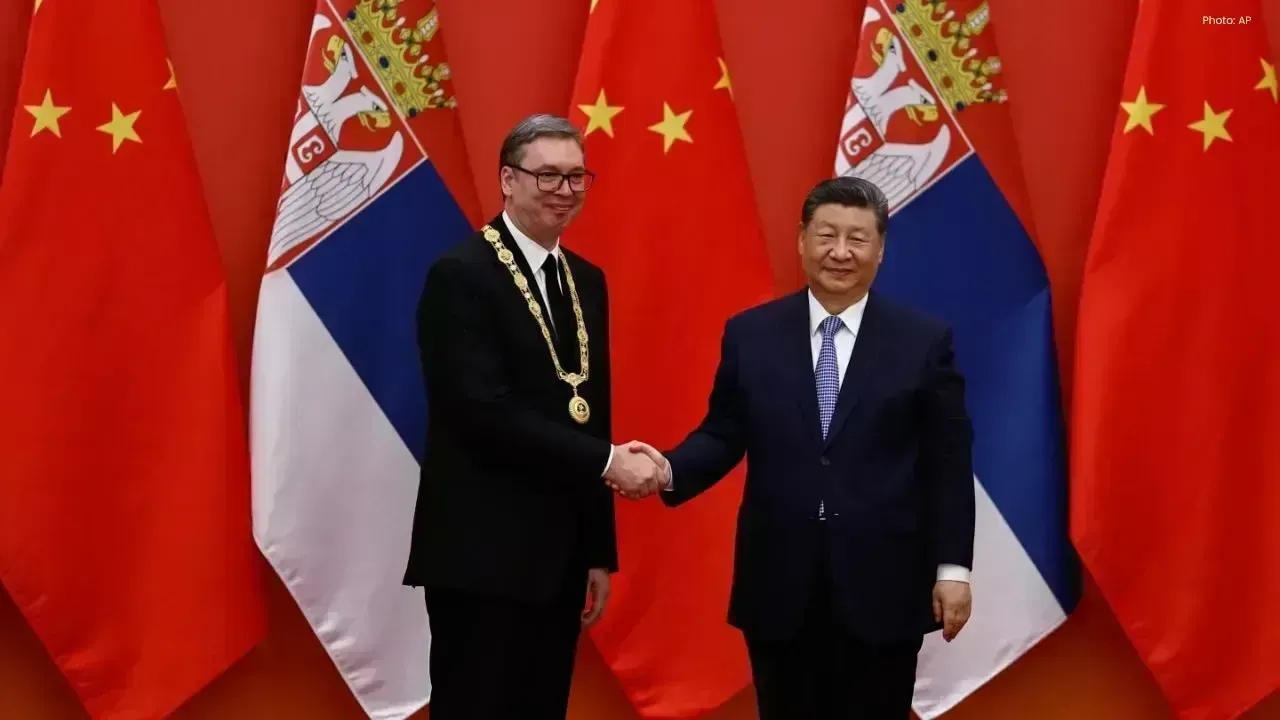
During an official trip to Beijing, Serbian President Aleksandar Vučić fortified the diplomatic and economic partnership with China, even as he encounters significant political turbulence from widespread anti-government demonstrations back home. This visit symbolized Serbia’s evolving strategic alliance with China at a time marked by internal political discord and the balancing act between Eastern and Western influences.
In their discussions, Chinese President Xi Jinping and Vučić witnessed the signing of over 20 agreements spanning trade, technology, education, governance, artificial intelligence, and sustainable energy. State media in China labeled these agreements as a move to enhance the thorough strategic partnership between both nations.
Xi Jinping affirmed his support for Serbia’s autonomous developmental journey, expressing China’s readiness to deepen governance and economic linkages. The two leaders highlighted the significance of multilateralism, sovereign equality, and bolstered cooperation in international frameworks while denouncing the politicization of human rights.
Discussions also placed a strong emphasis on future economic collaborations, especially in digital infrastructure, AI, and renewable energy sectors. In recent years, China has emerged as one of Serbia’s pivotal economic allies, making substantial investments in infrastructure and industrial projects throughout the Balkan region.
While Vučić strengthens international alliances globally, he is simultaneously grappling with escalating political obstacles domestically. Enormous protests erupted in Belgrade where tens of thousands stood against the government, calling for political reforms and accountability. The situation escalated over the weekend with confrontations between demonstrators and law enforcement, further straining the Serbian government.
The protests were ignited by the tragic collapse of a railway station structure in November 2024, intensifying public outrage regarding issues of corruption, transparency, and the fast-tracked approval of large foreign investment projects linked to China.
Although Serbia is pursuing EU membership, it continues to cultivate close political and economic ties with China and Russia. Vučić advocates for Europe to approach China through practical partnerships rather than suspicion and rivalry.
In an opinion piece shared during his visit, Vučić posited that dialogues around China in Europe are often influenced by irrational fears. He underscored that enhanced cooperation with Beijing could yield economic prospects and contribute to long-term development for Serbia and the surrounding area.
Political analysts suggest that Vučić’s journey to Beijing reflects Serbia’s ongoing effort to balance its European aspirations with growing relations in Asia and Eurasia. Nonetheless, experts caution that the mounting domestic unrest and public discontent regarding governance issues may pose challenges to Serbia’s political stability in the near future.








Suvarna Joy on Education Leadership, Resilience, and Building Purpose Through Adversity in the UAE
Suvarna Joy shares her journey of education leadership, motherhood, faith, and resilience within the

Anticipated Dates for UAE Eid Al Adha 2026 Unveiled by Astronomical Experts
Experts predict Eid Al Adha 2026 in the UAE to start on May 27, prompting early holiday planning amo

DAE Achieves Remarkable Growth in Q1 2026 With Record Revenue
Dubai Aerospace Enterprise announces impressive financial results for Q1 2026, reflecting a surge in

Price Increase for Sony PS5 in Southeast Asia Effective May 1
Sony announces a price increase for the PS5 across Southeast Asia starting May 1, 2026, impacting ga

Potential ‘Super El Niño’ in 2026: Understanding the Climate Risks
Could a Super El Niño emerge in 2026? Discover its implications and potential global climate impacts

Global Energy Crisis Intensifies: Markets React to Oil Supply Challenges
Markets are on edge as oil disruptions escalate, influencing prices and economic stability. Explore




