Post by : Monika
Photo : Reuters
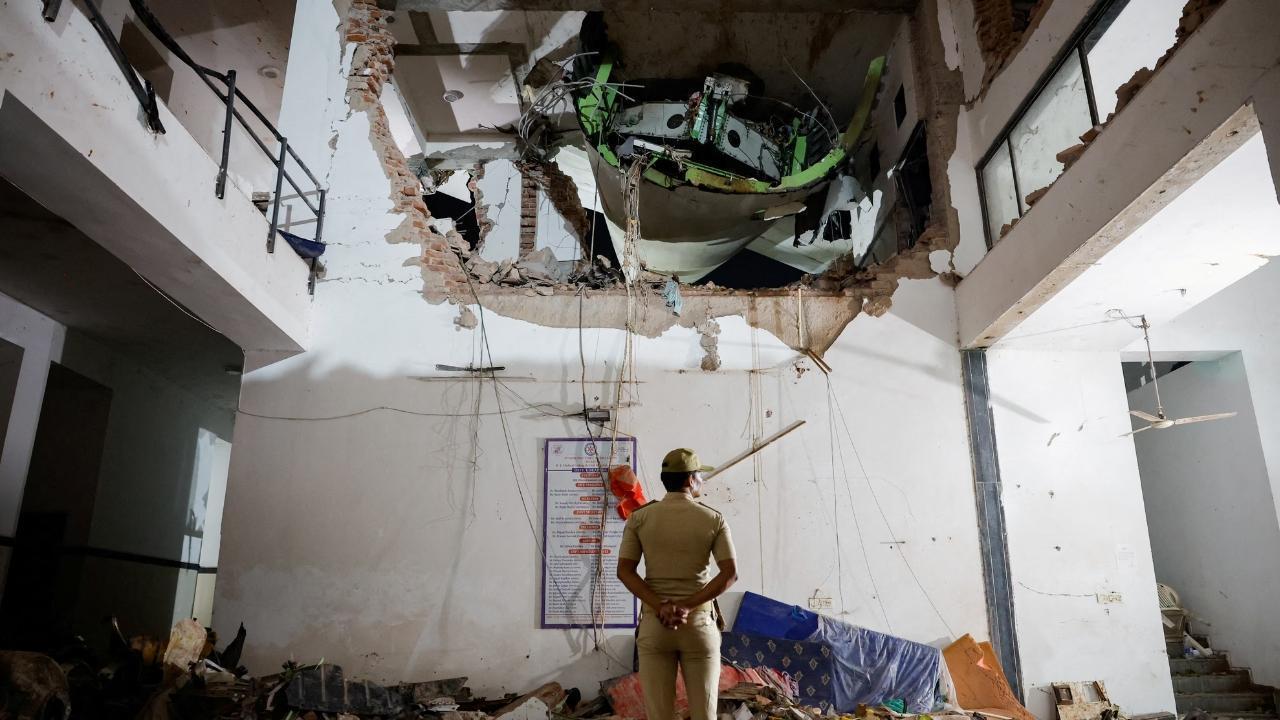
On June 12, 2025, a tragic accident happened just after an Air India Boeing 787 Dreamliner took off from Ahmedabad. The plane was on its way to London-Gatwick. But only a few seconds after takeoff, both of its engines stopped working.
The reason was shocking—both fuel control switches, which control the flow of fuel to the engines, had been turned off nearly at the same time. Without fuel, the engines lost power immediately. The aircraft dropped quickly and crashed into a building, killing 260 people.
This includes passengers, crew members, and people on the ground. It was the deadliest air crash in India in more than ten years.
Investigators from India’s Aircraft Accident Investigation Bureau (AAIB) began studying what went wrong. They checked the flight data recorder and the cockpit voice recorder, which record everything happening during a flight. They also watched CCTV footage from the airport.
The data showed that the two fuel switches had been flipped from the "run" position to the "cutoff" position right after the aircraft took off. There was only a one-second gap between the flipping of the first switch and the second one. This matches the amount of time it takes to move the switches one after the other by hand.
Once those switches were flipped to "cutoff," fuel stopped reaching the engines, and the engines failed. The CCTV cameras also showed the deployment of the ram air turbine, which is a small wind-powered device that comes out when the aircraft loses all power. This confirmed that both engines had stopped working.
Inside the cockpit, the voice recorder picked up a conversation between the two pilots. One of them asked, “Why did you shut off the fuel?” The other replied, “I did not.” This shows that even the pilots were confused about what had just happened. Investigators could not confirm who asked the question or who replied, and they are also unsure which pilot sent out the emergency distress call before the plane crashed.
The two pilots were both experienced. The captain, 56-year-old Sumeet Sabharwal, had over 15,600 flight hours and was also an instructor. His co-pilot, 32-year-old Clive Kunder, had logged about 3,400 flight hours. Together, they had flown more than 9,000 hours on the Boeing 787 Dreamliner.
This made it hard to believe that such experienced pilots would make a simple mistake with the fuel switches.
After the crash, investigators found that both fuel switches were back in the "run" position. This means someone in the cockpit had likely tried to restart the engines before the crash. One engine did manage to restart, but it was not able to provide enough power to lift the plane. Sadly, it was too late. The aircraft hit a building and exploded.
There were no signs of fire or mechanical failure before the fuel was shut off. This raised even more questions about how and why the fuel switches were turned off in the first place. On the Boeing 787 aircraft, these switches are designed so they cannot be moved by accident.
They are located below the engine throttle controls and are protected by a metal safety guard and spring. To move them, the pilot has to lift the switch up and then move it sideways. Experts say it is nearly impossible to switch them off without meaning to. This means the switches must have been flipped on purpose or as a result of some unknown issue.
Some flight safety experts from the United States have shared their thoughts. They say it is very unlikely for any pilot to turn off both fuel switches by mistake. If this was done by one of the pilots, the reason is not yet known. Investigators are trying to figure out whether it was a mistake, a deliberate act, or something else—like a sudden technical fault or confusion.
Even though investigators have found no signs of problems in the design of the aircraft or its engines, they are not ruling anything out yet. The plane was made by Boeing, and the engines were built by GE Aerospace
. Both companies are working with Indian authorities to support the investigation. The U.S. National Transportation Safety Board (NTSB) and the Federal Aviation Administration (FAA) are also watching the case closely. So far, no changes to the aircraft design have been suggested.
India’s aviation authorities have also started reviewing safety practices at Air India. They found some problems, like missed maintenance checks and pilots flying more hours than allowed. The European Aviation Safety Agency is also looking into Air India Express, which is part of the same company, because of other safety issues.
This accident has raised serious concerns about air travel safety in India. The aviation industry in the country has been growing fast. Air India is one of the oldest and most well-known airlines in India, and it was taken over by the Tata Group in 2022. People had high hopes for the airline’s future under new management. But this crash could damage public trust and raise questions about whether safety checks are being followed properly.
Here is a timeline of what happened in this case:
June 12, 2025: The flight takes off from Ahmedabad to London. Both engines stop seconds after takeoff. The plane crashes and kills 260 people, including 19 on the ground.
June 13: India’s Aircraft Accident Investigation Bureau starts its investigation.
Mid-June: The flight data recorders, or "black boxes," are found and taken to a lab in Delhi for analysis.
Late June: Data from the black boxes is studied carefully by experts.
July 11: The AAIB shares a preliminary report with early findings. No recommendations are made yet for Boeing or GE.
By July 2026: A full final report is expected to be released.
This crash is very important in the aviation world because it is the first deadly accident involving a Boeing 787 since the aircraft started flying in 2011. The main mystery still remains: why were both fuel switches turned off? Was it a human error, an accident, a hidden fault, or something else?
As of now, the AAIB continues to work on the full investigation. American agencies, Boeing, and GE are also helping. India's regulator has asked Air India to carefully inspect all other Boeing 787 planes in their fleet and to make sure all safety procedures are being followed.
In simple words, a critical switch was flipped during flight, and that caused the engines to lose power. The plane crashed, and many people lost their lives. The investigation is ongoing, and more answers will come in the months ahead.
If the final report finds a clear cause, it may lead to new rules or changes in how pilots are trained or how safety systems are designed. For now, everyone is hoping that lessons will be learned so such a tragedy never happens again.







DAE Achieves Remarkable Growth in Q1 2026 With Record Revenue
Dubai Aerospace Enterprise announces impressive financial results for Q1 2026, reflecting a surge in

Price Increase for Sony PS5 in Southeast Asia Effective May 1
Sony announces a price increase for the PS5 across Southeast Asia starting May 1, 2026, impacting ga

Potential ‘Super El Niño’ in 2026: Understanding the Climate Risks
Could a Super El Niño emerge in 2026? Discover its implications and potential global climate impacts

Global Energy Crisis Intensifies: Markets React to Oil Supply Challenges
Markets are on edge as oil disruptions escalate, influencing prices and economic stability. Explore

Must-See Tourist Spots in London You Can't Overlook
Explore London's essential attractions, from royal landmarks to vibrant markets, ensuring an unforge

Ultimate Guide to Snagging Cheap Flights in 2026
Unlock the secrets to booking affordable flights in 2026 with insightful tips and strategies tailore




