Post by : Monika
Photo: Reuters
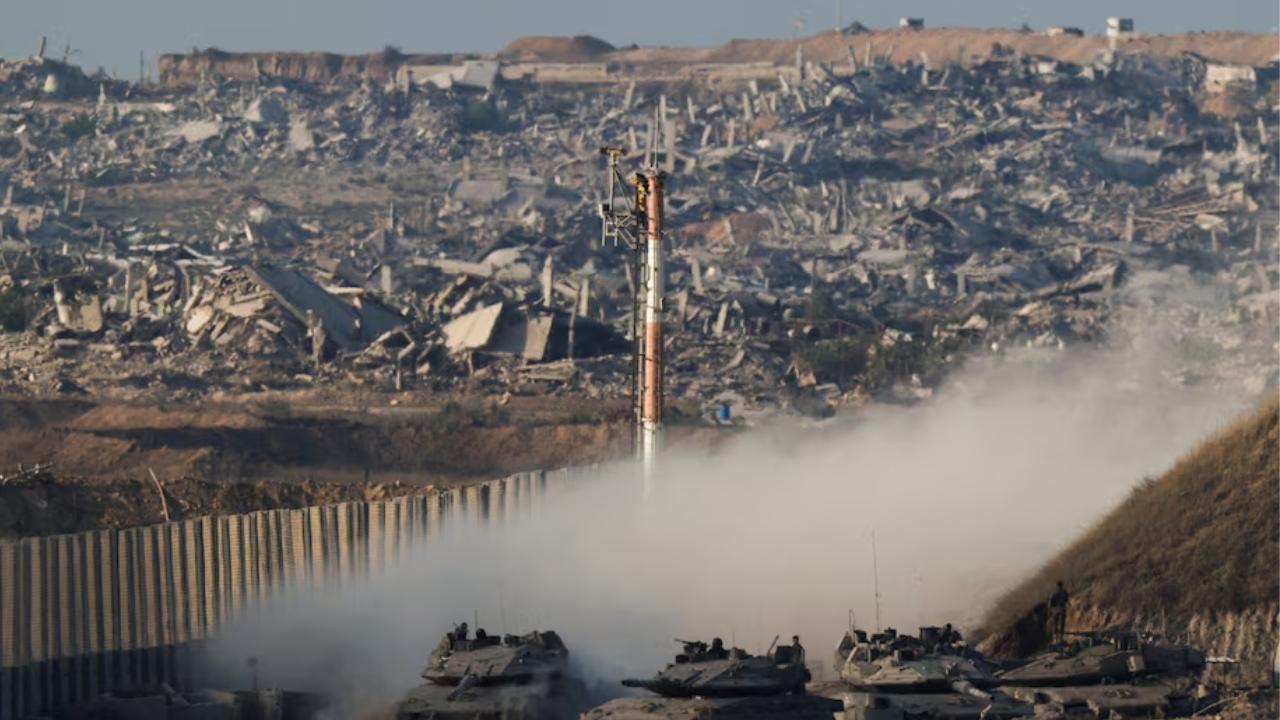
On Tuesday night, people in Gaza City faced another terrifying moment. Israeli tanks rolled into the Ebad-Alrahman neighborhood on the northern edge of the city. These heavy machines smashed through walls, houses, and narrow streets. The noise of tanks, engines, and crumbling buildings echoed across the area. Families living there panicked and rushed out of their homes in the middle of the night. Mothers held their children tightly, and fathers tried to guide their families to safer places.
For many, there was nowhere truly safe to go. Yet people ran anyway, hoping to escape the noise, the dust, and the fear that another round of fighting was about to begin.
Witnesses described the chaos. "We heard walls breaking and tanks moving closer. We had no choice but to leave everything and run," one resident said. The fear was clear in their voices, and it showed just how quickly life can change for ordinary families living in the middle of a war zone.
Why Israel Is Moving Deeper Into Gaza
Israel’s army explained that the tanks were preparing for a bigger operation. They said their focus is on what they call Hamas’s "last stronghold" inside Gaza City. The Israeli military believes that fighters are hiding in these crowded neighborhoods, and they want to destroy their positions.
But Gaza City is not just a battlefield. It is home to nearly half of Gaza’s two million people. Streets that were once filled with schools, markets, and busy shops have now become dangerous places. Many families are caught in between—the army’s orders to leave, and the difficulty of finding anywhere else to go.
Despite calls to evacuate, local church leaders and aid workers have chosen to stay. They say their duty is to care for the sick, the elderly, and children who cannot escape. "We cannot leave the people who need us most," one church member explained.
Families Struggle To Find Shelter
The Israeli military has tried to offer tents for families forced to leave their homes. Soldiers have set up temporary shelters in some areas. But these tents are far too few for the massive numbers of people needing help. The United Nations estimates that 1.5 million more people in Gaza need proper shelter, food, and clean water.
Aid workers warn that even if tents are provided, they cannot replace real homes. Families are living in crowded camps where there is little privacy, not enough toilets, and shortages of food and medicine. Mothers worry about keeping their children clean and safe, while fathers stand in long lines hoping for a small bag of flour or rice.
Life in these camps has become extremely hard. Children sleep on the ground, and diseases spread quickly in crowded spaces. Many families wonder how long they will have to live like this, and whether they will ever be able to return home.
The Human Cost Of The War
The numbers show the scale of suffering. According to Gaza’s Health Ministry, more than 62,000 Palestinians have lost their lives since the war began in October 2023. Thousands more have been injured. Entire neighborhoods have been destroyed, leaving families with nothing but memories of their former lives.
Food shortages have made the crisis even worse. Shops are empty, and aid trucks that enter Gaza are not nearly enough. Hunger is spreading quickly, especially among children. Some families say they go days without proper meals, surviving only on bread and water.
In Israel, people are also feeling the heavy cost of war. Families whose loved ones are still held hostage by Hamas have been protesting. They gather in public squares, holding signs and candles, asking the government to bring the hostages back home. Many also call for an end to the war, fearing more lives will be lost if the fighting continues.
Global Leaders Step In
The worsening crisis has drawn the attention of world leaders. On Wednesday, U.S. President Donald Trump is scheduled to chair a special meeting at the White House. The goal is to discuss possible ways to end the war. Trump has said he hopes the conflict might come to an end by the end of this year, though many experts remain unsure if that is possible.
At the same time, U.S. Secretary of State Marco Rubio will meet with Israel’s Foreign Minister Gideon Saar in Washington. Their talks are expected to focus on security, peace plans, and how to handle the humanitarian disaster unfolding in Gaza.
For many people, these high-level talks bring a small ray of hope. But for families inside Gaza, hope is mixed with doubt. They have seen promises before, and they know peace agreements are not easy to reach.
Why Peace Is So Hard To Achieve
These issues make it hard to find common ground. Even when leaders sit at the same table, reaching a deal requires many compromises—and both sides often feel they are giving up too much.
Voices From Gaza And Israel
In Gaza, many people say they only want safety for their families. "We are tired of running. We just want to live in peace," one mother said while carrying her baby in a blanket.
In Israel, some citizens share similar feelings. "We want our hostages back, but we also don’t want more bloodshed. This war has gone on too long," a protester explained.These voices show that ordinary people, on both sides, carry the heaviest burdens of war. They lose their homes, loved ones, and sense of security, while political leaders debate over strategies and conditions.
What Comes Next?
For now, the tanks remain in Gaza City, and families continue to flee from one area to another. Aid workers keep calling for more supplies, and hospitals struggle to treat the growing number of injured.
The world is watching the upcoming talks in Washington closely. Some believe that if the U.S. can pressure both sides, a temporary ceasefire might be possible. Others are less hopeful, pointing to past efforts that collapsed quickly.
Still, the hope for peace remains alive. For many families in Gaza and Israel, peace is not just a word—it is a dream they hold onto each day, even as the sounds of war surround them.
Why This Story Matters
The future is uncertain, but the need for peace is urgent. Every day the war continues, more families are broken apart, and more lives are lost. The world waits to see whether leaders can finally bring an end to this long and painful conflict.








Anticipated Dates for UAE Eid Al Adha 2026 Unveiled by Astronomical Experts
Experts predict Eid Al Adha 2026 in the UAE to start on May 27, prompting early holiday planning amo

DAE Achieves Remarkable Growth in Q1 2026 With Record Revenue
Dubai Aerospace Enterprise announces impressive financial results for Q1 2026, reflecting a surge in

Price Increase for Sony PS5 in Southeast Asia Effective May 1
Sony announces a price increase for the PS5 across Southeast Asia starting May 1, 2026, impacting ga

Potential ‘Super El Niño’ in 2026: Understanding the Climate Risks
Could a Super El Niño emerge in 2026? Discover its implications and potential global climate impacts

Global Energy Crisis Intensifies: Markets React to Oil Supply Challenges
Markets are on edge as oil disruptions escalate, influencing prices and economic stability. Explore

Must-See Tourist Spots in London You Can't Overlook
Explore London's essential attractions, from royal landmarks to vibrant markets, ensuring an unforge




